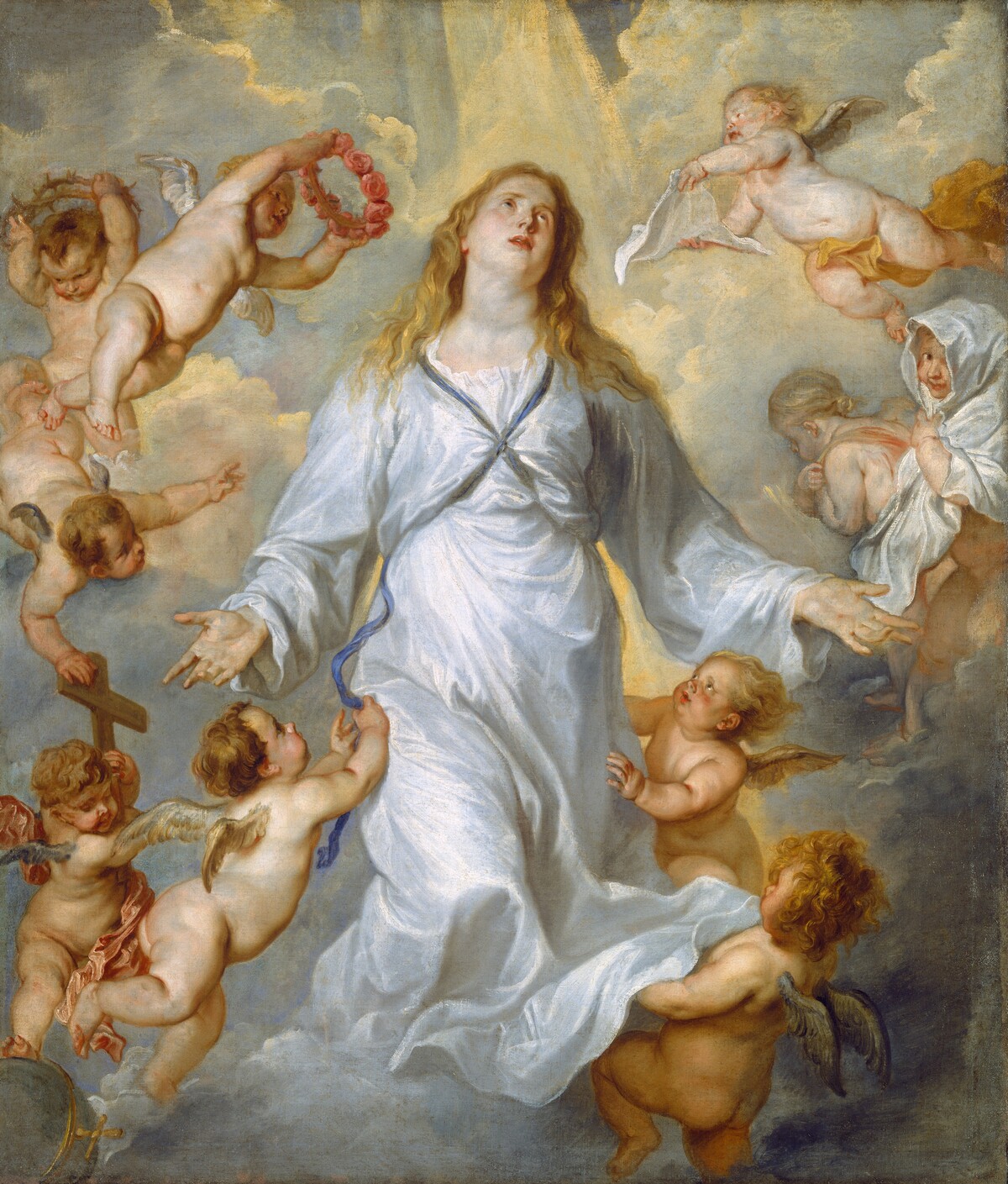
Provenance
Private collection, Antwerp, by 1670 until at least 1717. P. van de Copello, Amsterdam; sold 26 January 1774 to John Hope [1737-1784], Amsterdam;[1] his estate, Amsterdam and London;[2] by inheritance to his youngest son, Henry Philip Hope [1774-1839], London;[3] by inheritance to his nephew, Henry Thomas Hope [1808-1862], London and Deepdene, near Dorking, Surrey;[4] by inheritance to his widow, Adèle Hope-Bichat [d. 1884], London and Deepdene; by inheritance to her grandson, Henry Francis Hope Pelham-Clinton-Hope, 8th duke of Newcastle-under-Lyme [1866-1941], London, Deepdene, and Clumber Park, Nottingham;[5] sold 1898 to (Asher Wertheimer, London) on joint account with (P. & D. Colnaghi & Co., London and New York); sold 13 December 1898 to Peter A.B. Widener, Lynnewood Hall, Elkins Park, Pennsylvania;[6] inheritance from Estate of Peter A.B. Widener by gift through power of appointment of Joseph E. Widener, Elkins Park; gift 1942 to NGA.
[1] The Gallery's painting is shown hanging above a fireplace in a 1670 picture, _Visitors at a Gallery of Paintings_, by Hieronymus Janssens (Musée Girodet, Montargis, France). See J.W. Niemeijer, "De kunstverzameling van John Hope (1737-1784)," _Nederlands Kunsthistorisch Jaarboek_ 32 (1981): 179, no. 67. Van Dyck's painting was seen by Sir Joshua Reynolds in the Hope Cabinet in 1781 (see Sir Joshua Reynolds, "A Journey to Flanders and Holland in the Year MDCCLXXXI," _The Works of Sir Joshua Reynolds, Knight; late President of the Royal Academy_, 3 vols., London, 1798: 2:363). For a detailed account of the Hope Collection and the family history, see Niemeijer 1981.
[2] John Hope's estate, which was left to his three sons--Thomas [1769-1831], Adrian Elias [1772-1834] and Henry Philip [1774-1839]--was administered by the children's mother, Philippina Barbara van der Hoeven and their father's cousin, Henry Hope [1736-1811], who ran the family firm. After the mother's death in 1789, Henry Hope assumed control of the collection of paintings in Amsterdam.
In 1791 the three sons received the division of their mother's estate and a partial division of their father's estate. However the collection of paintings was not divided, but remained in the estate. On June 18, 1794, Thomas Hope, having attained his legal majority, received his inheritance, but he received no part of the collection, which remained in his father's estate, and which was taken by Henry Hope to London in 1794 when he and other members of the family fled the invading French army (See: Martin G. Buist _At spes non fracta. Hope & Co. 1770-1815: Merchant Bankers and Diplomats at Work_, The Hague, 1974: 42-43, 49; Niemeijer 1981, 166-169).
In London Henry Hope was in possession of the collection. On December 17, 1795, he signed insurance lists of 'Pictures in the House No. 1 the corner of Harley Street, belonging to Mr. Henry Hope," (see J.W. Niemeijer, "A Conversation Piece by Aert Schouman and the Founders of the Hope Collection," _Apollo_ 108 [September 1978]: 182-89). Included in the lists from catalogue B was "Van Dijck...Ascension of the Virgin...400," see: Buist 1974, 491.
[3] It is not clear when, and for what reason, Henry Philip Hope became the sole heir of the paintings, but he seems to have inherited the collection no later than 1819. After Henry Hope's death in 1811, possession of the collection presumably went to Thomas Hope, with whom it remained because of Henry Philip Hope's peripatetic life (see: Niemeijer 1981, 169). Thomas kept most of the paintings in his two London residences; first at 2, Hanover Square and, after 1819, off Portland Place in Duchess Street, where he designed and built a special gallery to house the collection (see: David Watkin, _Thomas Hope 1769-1831 and the Neo-Classical Idea_, London, 1968: 93). NGA 1942.9.88 was seen in Thomas Hope's Cabinet by C.M. Westmacott (_British Galleries of Painting and Sculpture_, London, 1824: 228).
[4] Henry Thomas Hope maintained the property and its collections on Duchess Street until 1851, when he moved to a new residence in Piccadilly (see: Niemeijer 1981, 170; and Ben Broos in _Great Dutch Paintings from America_, exh. cat., Mauritshuis, The Hague and The Fine Arts Museums, San Francisco, Zwolle, 1990: 422).
[5] Lord Pelham-Clinton-Hope lent the painting to the South Kensington Museum from 1891-1898.
[6] Date as mentioned in Widener card files, kept in NGA Department of Curatorial Records. However, Edith Standen recorded in her notes, in NGA curatorial files, that the painting was bought by P.A.B. Widener in 1899. A third source, Statement of Date of Acquisition and Cost of Items (...) Conveying the Widener Collection to the National Gallery of Art, kept in office of the NGA's Secretary-General Counsel, also indicates that 1899 was the date of purchase.
Accession Number
1942.9.88
Medium
oil on canvas
Dimensions
overall: 118.8 x 102.3 cm (46 3/4 x 40 1/4 in.)
Classification
Painting
Credit Line
Widener Collection