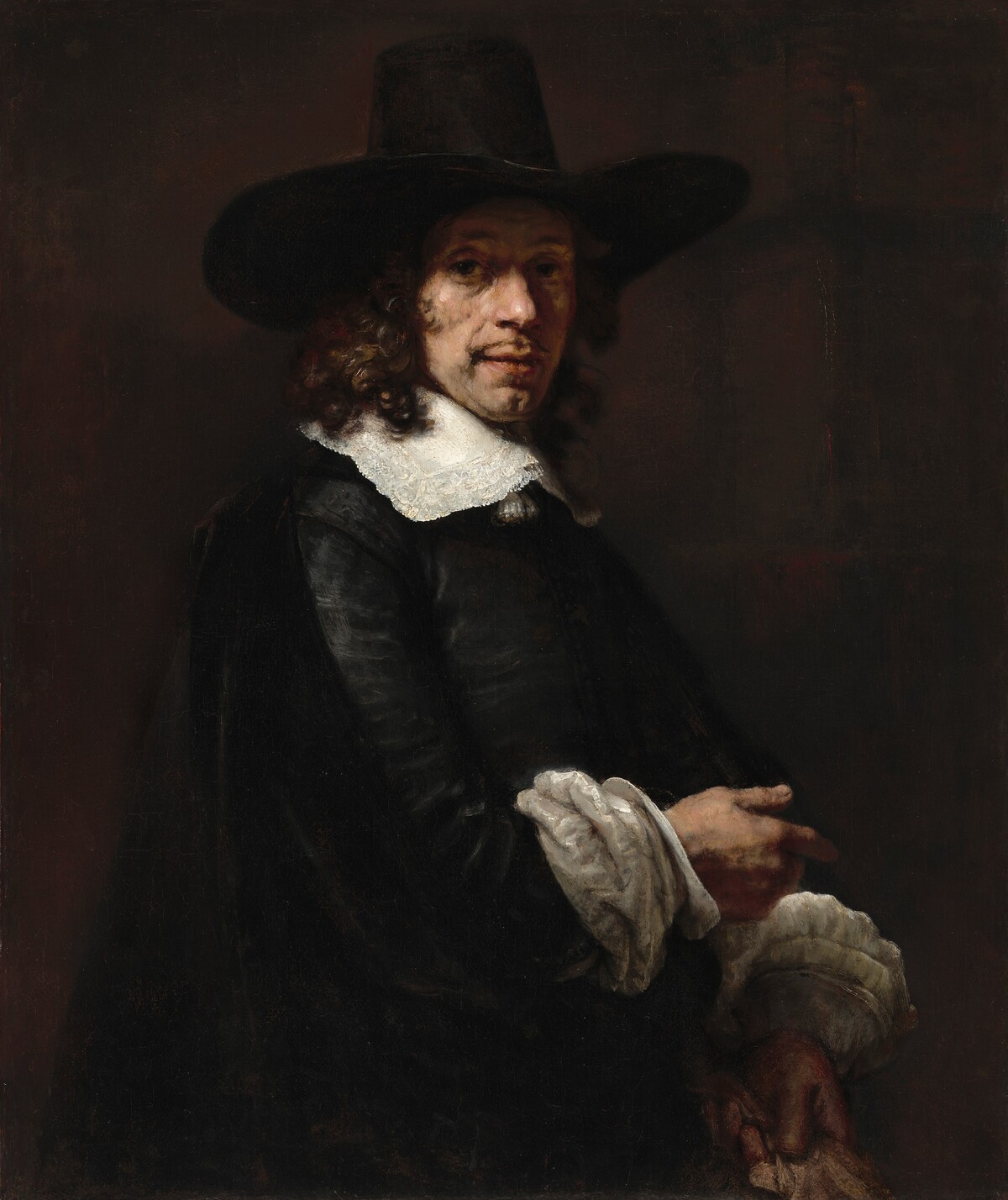
Provenance
Possibly Gerard Hoet, Jr. [d. 1760], The Hague; possibly (sale, by Ottho Van Thol, Huibert Keetelaar, and Pierre Yver, The Hague, 25 August 1760, no. 49).[1] Prince Nicolai Borisovich Yusupov [1751-1831], Saint Petersburg and Moscow, by 1803;[2] by inheritance to his son, Prince Boris Nicolaiovich Yusupov [1794-1849], Moscow and Saint Petersburg; by inheritance to his son, Prince Nicolai Borisovich Yusupov [1827-1891], Saint Petersburg; by inheritance to his daughter, Princess Zinaida [Zenaida] Nikolaievna Yusupova [1861-1939], Saint Petersburg, Yalta, and London;[3] sold 1921 by her son and heir, Prince Felix Felixovich Yusupov [1887-1967],[4] to Joseph E. Widener; inheritance from Estate of Peter A. B. Widener by gift through power of appointment of Joseph E. Widener, Elkins Park, Pennsylvania, after purchase by funds of the Estate; gift 1942 to NGA.
[1] Gerard Hoet, _Catalogus of Naamlyst van Schilderijen..._, 2 vols., The Hague, 1752, supplement by Pieter Terwesten, 1770, reprint ed. Soest, 1976, 3: 225, no. 49. The painting is listed as: "Een Mans-Pourtrait, met twee Handen, door _denzelven_; hoog 39, breet 30 1/2 diumen."
[2] On the formation and history of the Yusupov collection see: Pushkin State Museum of Fine Arts, _A Scholar's Whim: Collection of Prince Nicolai Borisovich Yusupov_, 2 vols., Moscow, 2001; Oleg Yakovlevich Neverov, _Great Private Collections of Imperial Russia_, New York and St. Petersburg, 2004: 89-102; State Hermitage Museum, _Collectors in St. Petersburg_, exh. cat., Hermitage Amsterdam, Zwolle, 2006: 23, 37-47. The German traveller Heinrich Christoph von Reimers (1768-1812) visited the collection in 1803 when it was housed in the family's palace on the Fontanka River in Saint Petersburg; his description of it, published in 1805, mentions the Gallery's painting, and its pendant NGA 1942.9.68. See Heinrich Christoph von Reimers, _St. Petersburg, am Ende seines Ersten Jahrhunderts_, 2 vols., Saint Petersburg, 1805: 2:373.
The spelling of the family name takes a variety of forms in the literature, reflecting different transliterations of the Cyrillic letters; among them are: Youssoupoff, Yussupov, Jussupov, and Yussupoff.
[3] The princess was the wife of Felix Felixovich, count Sumarokov-Elston (1856-1928), but she was the last surviving representative of the Yusupov family, and her husband was given the right to take his wife's surname and title. The Yusupov art collection, however, was hers, and, after the death in 1908 of her first son, Nicolai, the heir to it became her second son, Felix.
[4] The Yusupov collection, including the two portraits by Rembrandt, was moved in 1811 from Saint Petersburg to the family's Arkhangelskoye estate near Moscow, where it survived Napoleon's invasion of Russia during 1812, and was returned again to Saint Petersburg in 1837 to a new family palace on the Moika River. It remained there until sometime after the Russian Revolution of 1917, when much of the collection was seized by the Bolshevik government. The two Rembrandt paintings, however, were smuggled out of the Moika Palace at some point prior to April 1919, when Prince Felix Felixovich Yusupov, his wife and parents, and other members of the Russian nobility left Yalta aboard a British ship. The paintings were taken by the prince to London, where negotiations for their sale began.
Accession Number
1942.9.67
Medium
oil on canvas transferred to canvas
Dimensions
overall: 99.5 × 82.5 cm (39 3/16 × 32 1/2 in.) | framed: 132.08 × 114.94 × 13.97 cm (52 × 45 1/4 × 5 1/2 in.)
Classification
Painting
Credit Line
Widener Collection