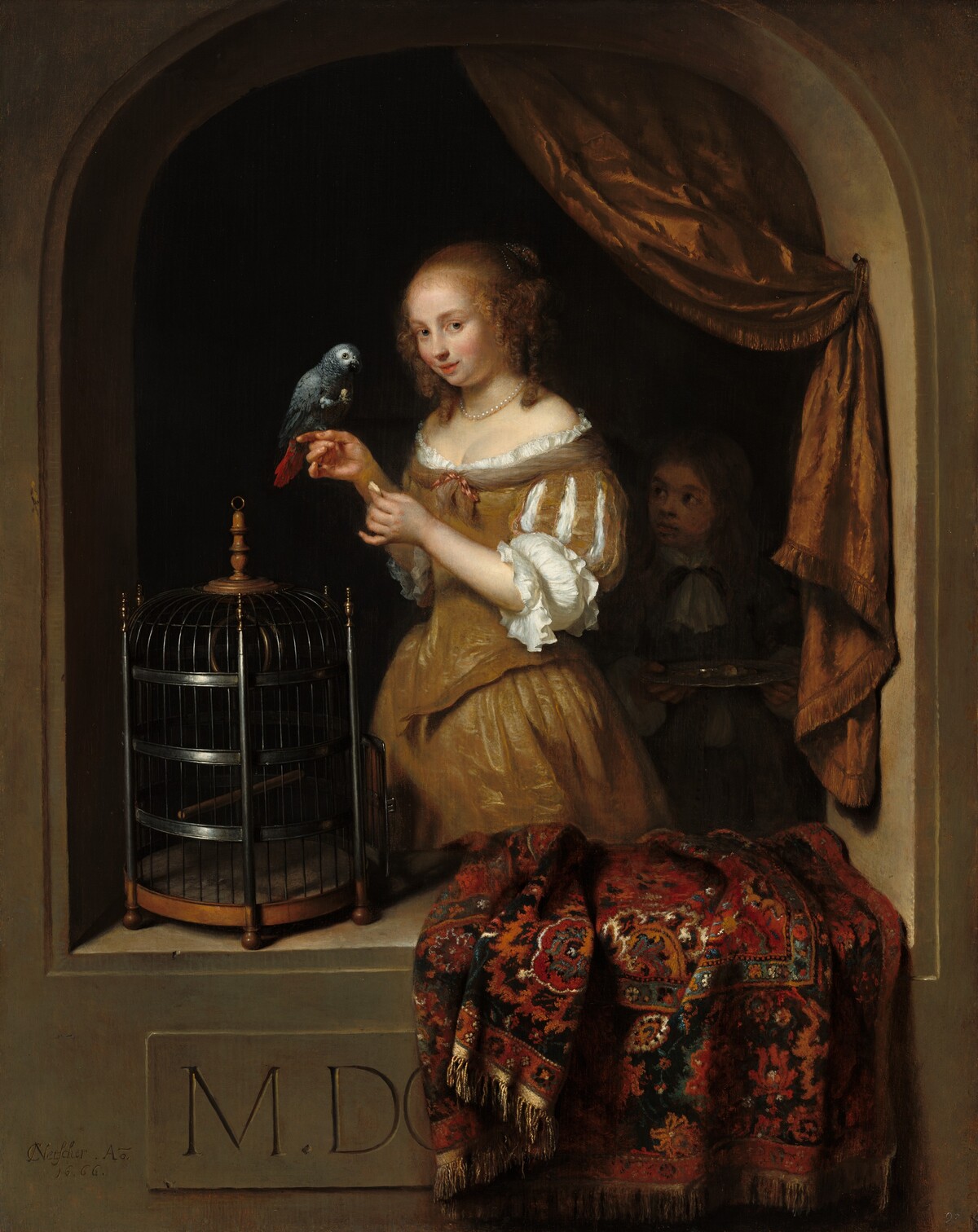
Provenance
The artist.[1] purchased 1674 for 140 guilders by (Gerrit Uylenburgh, Amsterdam);[2] consigned by 19 April 1675 to Sir Peter Lely (1618-1680), London.[3] possibly Pierre Plongeron [d. 1694], The Hague.[4] Johann Wilhelm II, Elector Palatine [1658-1716], Düsseldorf; transferred with the collection first to the elector’s Palace in Mannheim, then to the Alte Pinakothek, Munich;[5] sold 1936 to (Julius Böhler, Munich). (Firma D. Katz, Dieren), in 1937. Hugo Daniel [1867-1942] and Elisabeth J. Spanjaard [1871-1963] Andriesse, Brussels, by 1938.[6] (Kunsthandlung Abels, Cologne), in 1950; Rudolf Ziersch, Wuppertal; gift 1952 to the Von der Heydt-Museum, Wuppertal;[7] restituted 2014 to the heirs of Hugo and Elisabeth Andriesse;[8] (sale, Christie, Manson & Woods, New York, 4 June 2014, no. 16); (Richard Green Fine Paintings, London); purchased October 2016 by NGA.
[1] Inscribed on the verso of the _ricordo_ (study drawing) for the painting (now in the Department of Prints and Drawings, British Museum, London, number Oo,11.250), in the artist’s hand, is the following: “Het steen byde Jonge moet hee.. maeesen / gelyck aende andre zyde / Geschildert voor h..d..[crossed out] guldens / 1666” (The stone[work] next to the boy [possibly ‘has to be whole’] / just like the other side / Painted for h..d..[crossed out] guilders / 1666). The “h” can only stand for “honderd” (hundred), while the “d” represents either the middle “d” of the word honderd, or the start of the word “dertig” (thirty), indicating that the artist sold the painting for either one hundred or one hundred and thirty guilders. See: Marjorie E. Wieseman, _Caspar Netscher and Late Seventeenth-Century Dutch Painting_, Doornspijk, 2002: 207, no. 54.
[2] Uylenburgh (1625-1679) was both a painter and an art dealer, having taken over the business of his father, Hendrick Uylenburgh (1584/1589-1661). Following a dispute over the sale of art to the Elector of Brandenburg in the early 1670s, Uylenburgh’s fortunes declined and claims by creditors resulted in his case being referred to the Amsterdam Bankruptcy Chamber in early 1675. In April a complete inventory and appraisal of his possessions, including paintings, was made, in which Uylenburgh lists as no. 89 “Young woman with a parrot by Netscher, the same as I paid in cash last year – 140” (Amsterdam Municipal Archives, archive o.5072, inv. no. 1573, item 340; the appraisal is undated, but the accompanying agreement between Uylenurgh and his creditors is dated 19 April 1675). See Friso Lammertse and Jaap van der Veen, _Uylenburgh & Son: Art and Commerce from Rembrandt to De Lairesse, 1625-1675_, Zwolle and Amsterdam, 2006: 301-302, no. 89, 303 n. 1, 305 n. 84.
[3] In the appraisal of 1675 (see note 2), the Netscher is included in a list of eight paintings described as being “with Mr. Pieter Lelij in England.” Lely trained as a painter in Haarlem and left for England in 1641. Appointed court painter to King Charles II in 1661, he was also an art collector as well as being known as a “trusty and well beloved friend” of the Uylenburgh family; he served as their representative when Gerrit’s brother Abraham died in Dublin in 1668. See: Lammertse and Van der Veen 2006, 70, 77. The eight paintings seem to have been with Lely on commission, and he may have purchased one or more for his own collection, although the Netscher does not appear to be listed in the catalogue of Lely’s collection when it was sold at auction on 18 April 1682, unless it was one of the many paintings titled _A Woman_. See: Diana Dethloff, “The Executors’ Account Book and the Dispersal of Sir Peter Lely’s Collection,” _Journal of the History of Collections_ 8, no. 1 (1996): 15-51.
[4] Plongeron was agent and chamberlain to the Elector Palatinate. His estate inventory of 27 September 1694 lists “een vrouwtien geschildert op peneel met papegaij op de hant, van Netsgaer” (a woman on panel with parrot on the hand, by Netsger). See: Wieseman 2002, 207, no. 54, 142, document 98 (incorrectly indicated as document 95 on p. 207).
[5] The painting was first published in 1751 by Johan van Gool, _De Nieuwe Schouburg der Nederlantsche Kunstschilder en Schilderessen_, 2 vols., The Hague, 1751: 2:562, where it is listed as hanging in the “second cabinet” of the Elector’s palace in Düsseldorf. It has not yet been identified in the early catalogues of the art owned by the Electors Palatine. It was number 1399 in the collection of the Alte Pinakothek.
[6] Hugo Andriesse, a Dutch industrialist and philanthropist living in Brussels, lent the painting to an exhibition in Rotterdam that opened in late 1938 (on Andriesse, see email dated 26 August 2022 from family member in curatorial file). In 1939 he deposited it, with other paintings from his collection, with the Musées Royaux des Beaux-Arts, Brussels, before fleeing Europe with his wife and eventually settling in New York. From there, after the Germans occupied Belgium during World War II, the painting was confiscated with the rest of the Andriesse collection on 3 December 1941 by the Einsatztab Reichsleiter Rosenberg (ERR no. HA 9), and on 12 March 1942 transferred to the Jeu de Paume, in Paris. On 20 March 1944 it was acquired for the Nazi’s Reichsmarshall Hermann Goering (RM no. 1203), and transferred to Goering’s “Kurfürst Bunker,” a command center for the Nazi Luftwaffe, in Potsdam. See the record for the painting at the Cultural Plunder by the ERR website: https://www.errproject.org/jeudepaume/ (accessed 30 June 2017). The 1985 catalogue of 17th century Dutch paintings in the Von der Heydt Museum, Wuppertal, lists the Wallraf-Richartz-Museum in Cologne in the provenance; this has not yet been confirmed.
[7] The painting was number 659 in the museum’s collection.
[8] Hugo and Elisabeth Andriesse had no children; the heirs were the charities named in Mrs. Andriesse's will.
Accession Number
2016.118.1
Medium
oil on panel
Dimensions
overall: 45.7 × 36.2 cm (18 × 14 1/4 in.)
Classification
Painting
Credit Line
The Lee and Juliet Folger Fund