Provenance
Commissioned by Augustus III, king of Poland and elector of Saxony [1696-1763].[1] Henry Temple, 2nd viscount Palmerston [1739-1802], London;[2] by inheritence to his son Henry John Temple, 3rd viscount Palmerston [1784-1865], London; (sale, Foster’s, London, 5 November 1850, no. 290);[3] (Anderson); Henry, 4th earl Beauchamp [1784-1863], Madresfield Court, Worcestershire;[4] by inheritance to Else, countess Beauchamp [1895-1989];[5] (sale, Sotheby's, London, 11 December 1991, no. 18); (Bernheimer Fine Arts Ltd., London and Munich, and Meissner Fine Art Ltd., Zurich and London); sold 3 June 1993 to NGA.
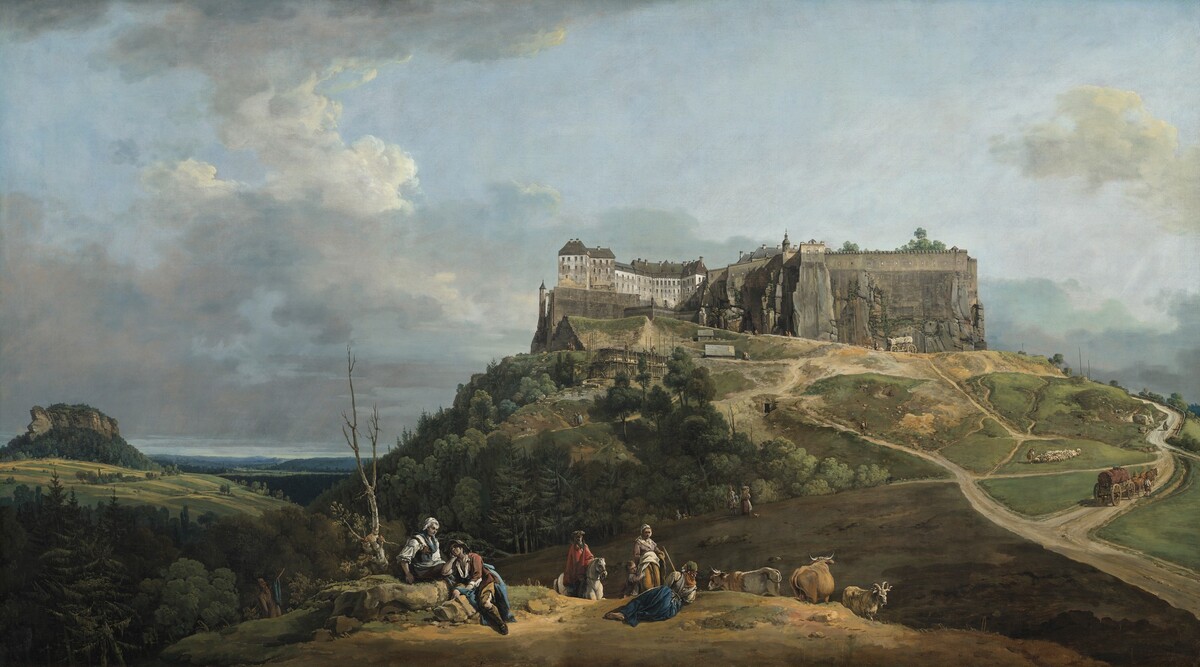
[1] Five views of Königstein were commissioned and executed on canvases of the same size and format between 1756 and 1758. They were intended to complete the earlier views of Dresden and Pirna painted for the king and to be placed in the Stallgebäude, the wing of the royal palace that housed the paintings collection. The commission was interrupted, however, by the hostilities of the Seven Years' War (1756-1763), and the paintings were never delivered to the royal collection. It is unclear whether Bellotto had finished all the paintings before he departed Dresden in 1758; four views of Königstein were listed in a catalogue of his apartment contents made before he left the city, which he returned to in 1761 for five years. (See Lucy Chiswell, “Bernardo Bellotto and the Fortress of Königstein,” in _Bellotto: The Königstein Views Reunited_, exh. cat. London, 2021: 34, 39, n. 19.) The paintings might have been seized by the Prussians during the siege of Dresden, Pirna, and Königstein, and then sold. Alternatively, following the disarray of the Saxon court and the depletion of its treasury, Bellotto might have retained the canvases and sold them privately. In 1765, he published a large etching of the Washington painting, as well as one of the painting now in the collection of the earl of Derby, Knowsley Hall (as of 2021). By the late eighteenth century all five paintings had arrived in England; the first two came to light in a sale at Christie's, London, 7 March 1778, lots 79 and 80, described as "A View of the fortress of Koningstein [sic] in Saxony, painted for the King of Poland. A ditto, its companion" (sale catalogue, Christie, Manson, and Woods, _Catalogue of the capital collection of Italian, French, Flemish and Dutch pictures_). Both passed to the collection of the marquess of Londonderry, Wynyard Park, Durham, and were acquired by the City Art Gallery, Manchester, in 1983 (James Byam Shaw, "Two Views of the Castle of Königstein by Bernardo Bellotto," _National Art Collections Fund Review_ [1984]: 139-140).
[2] The 2nd viscount Palmerston, a Whig politician who served 40 years in Parliament, acquired three Königstein paintings in the 1790s. Now in the National Gallery of Art, the National Gallery, London, and the collection of the earl of Derby, all three retain the gilt-wood frame Lord Palmerston had made for them in the 1790s. Where and when he acquired the paintings is unknown. They hung in his London House in Hanover Square, which he acquired in 1790. However, alterations were still being made to the property in 1796, when he moved in, so it is unlikely that the paintings were there before that date (Connell, Brian, _Portrait of a Whig Peer. Compiled from the Papers of the Second Viscount Palmerston 1739-1802_, London, 1957: 208-209, 259-260, 346). The earliest reference to Bellotto in the Palmerston collection is found an undated inventory (paper watermarked 1796), "Catalogue of Pictures belonging to Lord Palmerston in Hanover Square," which records a "View of Keenigsteen” (sic) by “Cannaletti." (Bellotto, like his more famous uncle, was called both Canaletto and Canaletti in the eighteenth and nineteenth centuries.) It was valued at 250 pounds, but this may refer to all three Königstein paintings (Stephen Lloyd, “Bellotto, Britain, and the Königstein Paintings,” in London, 2021: 44). One of the paintings is recorded after Lord Palmerston's death in an undated manuscript (paper watermarked 1804) of "Pictures in Stanhope Street and Hanover Square" as "Cannaletti Koningstein 105 pounds" (Sotheby's 1991 sale catalogue, 37, citing Broadlands Papers, Southampton University Library Archives and Manuscripts, BR 126/11 and BR 126/15).
[3] The long-held family tradition that the 3rd Lord Palmerston gave it, perhaps to pay a debt, to William Lygon, 1st earl Beauchamp [1747-1816], Madresfield Court, Worcestershire (as recounted in Sotheby's 1991 sale catalogue, 37), is contradicted by a copy of the 1850 Foster’s sale catalogue marked as having been sold for 99 pounds, 15 shillings to “Anderson” (Getty Provenance Index, Br-5804, Lot 0290). The painting is described as “A View of Koenigstein on the Elbe, cattle and group of figures in the costume of the time in the foreground; the buildings and figures on this remarkable height are beautifully sketched in, and the environs and approaches painted with great truth and power.” (The NGA was alerted to the existence of the Foster’s sale catalogue by Letizia Treves, curator the National Gallery, London. See email of 22 February 2021 in curatorial records, as well as Lloyd, pp. 43-45 and 47, n. 18).
[4] See note 3 for reference to Anderson. According to the provenance of the painting reconstructed in the 2021 London exhibition catalogue (p. 56), Anderson was probably the agent purchasing for Henry, 4th Earl Beauchamp (1784-1863).
[5] The painting is mentioned as belonging to the earl Beauchamp in an 1875 catalogue of the collection of the earls of Derby. (Scharf, George, _A Descriptive and Historical Catalogue of the Collection of Pictures at Knowsley Hall_, London, 1875: 10, at end of entry for no. 17. Digitized by the GRL, accessed 11 November 2021.) The painting presumably descended to his son, Henry, 5th earl Beauchamp (1829-1866); his brother, Frederick, 6th earl Beauchamp (1830-1891); his son, William, 7th earl Beauchamp (1872-1938); his son, William, 8th earl Beauchamp (1903-1979); and then to his wife, Else, countess Beauchamp (1895-1989).
Accession Number
1993.8.1
Medium
oil on canvas
Dimensions
overall: 133 x 235.7 cm (52 3/8 x 92 13/16 in.) | framed: 159.4 x 263.5 x 6.4 cm (62 3/4 x 103 3/4 x 2 1/2 in.)
Classification
Painting
Credit Line
Patrons' Permanent Fund