Provenance
Corner (Cornaro) family, Venice; John Udny [1757-1800], British Resident in Venice; Angelica Kauffmann [1741-1807], painter, Rome;[1] probably acquired from her estate by Antonio Canova [1757-1822], sculptor, Rome; gift 1816 to William Richard Hamilton [1777-1859], London;[2] his descendants until the early twentieth century.[3] (P. and D. Colnaghi, London). (Howard Young Galleries, New York), in 1930. William R. Timken [1866-1949], New York, by 1933;[4] by inheritance to his widow, Lillian Guyer Timken [1881-1959], New York; bequest 1960 to NGA.
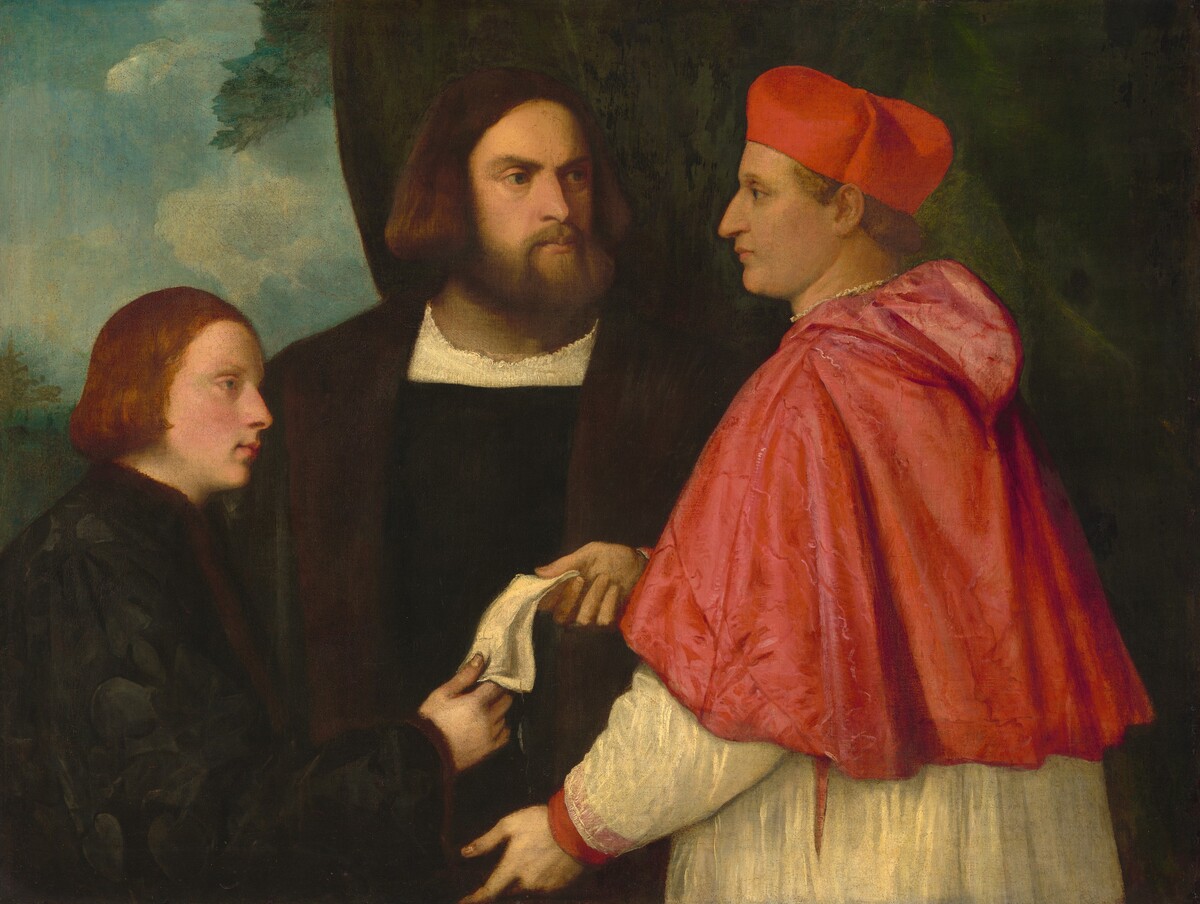
[1] The transfer of ownership from the Corner family to Kauffmann by way of Udny is documented by a letter of 1788 from Gavin Hamilton to the dealer G.M. Sasso in Venice. Hamilton mentions that Angelica Kauffmann (Zucchi) owned “un bel quadro di ritratti di casa Cornaro di Tiziano. Ha sofferto ed è molto ridipinto, ma è stato bello. Era di mister Udny, e facilmente è uscito da questa casa” (A beautiful portrait of members of the Corner family by Titian. It is very damaged and has been much repainted, but it has been beautiful. It formerly belonged to Mr Udny, who acquired it without difficulty from the family); see Francesca Del Torre, “Gavin Hamilton a Giovanni Maria Sasso,” in _Lettere artistiche del Settecento veneziano_, ed. Alessandro Bettagno and Marina Magrini, 4 vols., Vicenza, 2002-2009: 1(2002):450-451. Kauffmann herself mentions the picture in her will of 1803: “A fine painting by Titian, three half-figures, portraits of the old family Cornaro of Venice” (Victoria Manners and George Charles Williamson, _Angelica Kauffman, R. A.: Her Life and Her Works_, London, 1924: 244). The identification of the subject as three members of the Corner family in half-length, the attribution to Titian, and the mention of the poor condition of the picture together make it virtually certain that it is identical with the Gallery’s picture.
[2] The gift, recorded in the inscription on the back of the painting, was made following Canova’s meeting with Hamilton in Paris in 1815. Hamilton, British Undersecretary of State for Foreign Affairs, played a leading role in forcing the French government to return many of the artistic spoils seized by Napoleon from the papal states; and in token of his gratitude, Canova presented to him not only the NGA picture, but one of his _Ideal Heads_ (Ashmolean Museum, Oxford, 1996.395), and a handsomely bound volume of engravings after Titian (Katherine Eustace, ed., _Canova: Ideal Heads_, Oxford, 1997: 30 n. 76; Giuseppe Pavanello, “La collezione di Antonio Canova: Dipinti e disegni dal Quattrocento all’Ottocento,” in _Antonio Canova e il suo ambiente artístico fra Venezia, Roma e Parigi_, ed. Giuseppe Pavanello, Venice, 2000: 334). Presumably Canova acquired the picture from the estate of Kauffmann, who had died in 1807 (see note 1).
[3] In common with the other gifts from Canova to Hamilton (see note 2).
[4]The painting was published in Lionello Venturi, _Italian Paintings in America, Vol. 3: Sixteenth to Eighteenth Century_, translated by Countess Vanden Heuvel and Charles Marriott, 3 vols., New York and Milan, 1933: 3:512, as being in the Timken collection.
Giacomo and Cardinal Marco, investing Andrea, Abbot of San Zeno, with his Benefice
Anonymous Artistc. 1524
Accession Number
1960.6.38
Medium
oil on canvas
Dimensions
overall: 99.8 x 132.1 cm (39 5/16 x 52 in.) | framed: 137.8 x 170.2 x 11.6 cm (54 1/4 x 67 x 4 9/16 in.)
Classification
Painting
Credit Line
Timken Collection