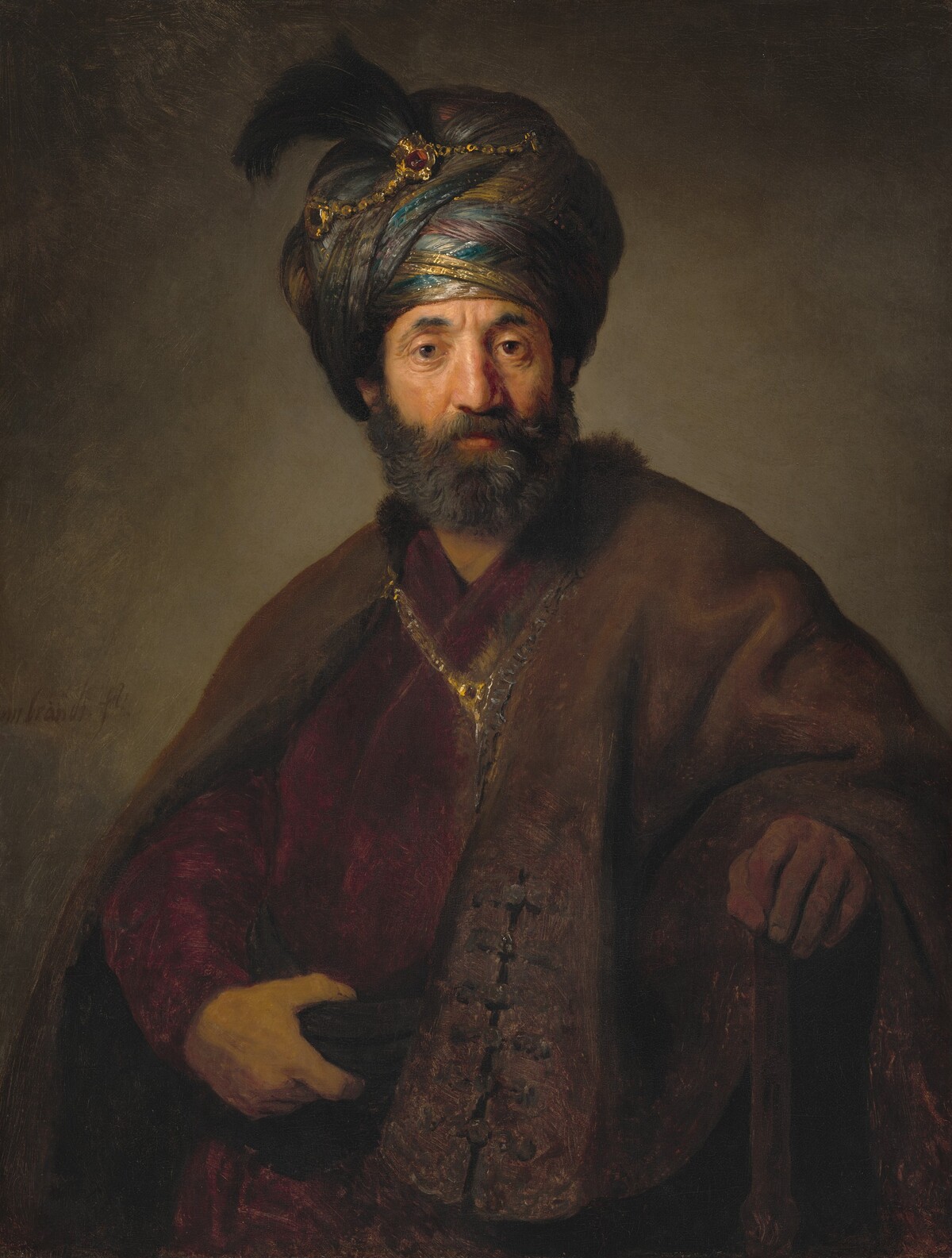
Provenance
Johan Ernst Gotzkowsky [1710-1775], Berlin, by 1756 until at least 1766;[1] sold to Heinrich, prince of Prussia [1726-1802];[2] sold to Catherine II, empress of Russia [1729-1796], Saint Petersburg, by 1773;[3] Imperial Hermitage Gallery, Saint Petersburg; sold between June 1930 and April 1931, as a painting by Rembrandt, through (Matthiesen Gallery, Berlin; P. & D. Colnaghi & Co., London; and M. Knoedler & Co., New York) to Andrew W. Mellon, Pittsburgh and Washington; his estate; deeded 8 March 1938 to The A.W. Mellon Educational and Charitable Trust, Pittsburgh; gift 1940 to NGA.
[1] Gotzkowsky originally bought the picture on behalf of Friedrich II (the Great), king of Prussia (1712-1786). Due to the financial straits of Prussia during the Seven Years' War (1756-1762), the painting remained in Gotzkowsky's hands. The inscription on a reproductive etching of the painting (in reverse) by Georg Friedrich Schmidt notes that it was in Gotzkowsky's collection in 1756, and Burton Fredericksen kindly brought to the Gallery's attention two catalogues of the Gotzkowsky collection that include the painting and thus extend Gotzkowsky's ownership (see letter of 2 January 2003 to Arthur Wheelock and e-mails of 2 April and 14 July [first message] 2003 to Molli Kuenstner, in NGA curatorial files). The first catalogue is Matthieu Oesterreich's _Description de quelques tableaux de différens Maîtres_ (published 1757), in which the painting is number 33. The second, also compiled by Oesterreich, is _Catalogue d'une très-belle collection de tableaux de différens Maîtres italiens, flamands, allemands et françois laquelle se trouve dans la maison de Mr. Ernest Gotzkowsky_ (Berlin, 1766). Fredericksen determined that the second catalogue includes paintings that Gotzkowsky had not sold to Catherine II, empress of Russia, which is confirmed by the fact that there is only a single Rembrandt painting included, number 146, the NGA painting, whereas Catherine had acquired more than a dozen Rembrandt paintings from Gotzkowsky in 1764. Fredericksen writes of the 1766 Gotzkowsky catalogue: "...in general [the paintings] do not appear to be of comparable importance to those we know had been sold. So we are undoubtedly dealing with the remnants of the collection as it appeared after the transaction of 1764."
[2] Gerd Bartoschek and Christoph Frank have located the painting in inventories of the Prince's collections. See: Gerd Bartoschek, _Flämische Barockmalerei in der Bildergalerie von Sanssouci_, Potsdam, 1985: 79-80; Christoph Frank, "Die Gemäldesammlungen Gotzkowsky, Eimbke und Stein: Zur Berliner Sammlungsgeschichte während des Siebenjährigen Krieges," in Michael North, ed., _Kunstammeln und Geschmack im 18. Jahrhundert_, Berlin, 2002: 117-194; Christoph Frank, "Un ours, un suicide et quelques tableaux. Le rôle de Berlin dans la constitution des collections rembranesques en Russie, à l'époque de Catherine II," in _Rembrandt et son école: Collections du musée de l'Ermitage de Saint-Pétersbourg_, exh. cat., Musée des Beaux-Arts de Dijon, Paris, 2003: 51-63. Burton Fredericksen brought Frank's research to the Gallery's attention (see e-mails of 14 July 2003 [both messages] and 23 February 2004, to Molli Kuenstner, in NGA curatorial files).
[3] [Ernst von Münnich.] "Catalogue raisonné des tableaux qui se trouvent dans les Galeries, Sallons et Cabinets du Palais Impérial de S. Pétersbourg, commencé en 1773 et continué jusqu’en 1785.” 3 vols. Manuscript, Fund 1, Opis’ VI-A, delo 85, Hermitage Archives, Saint Petersburg,1773-1785: 1:no.124.
Accession Number
1940.1.13
Medium
oil on linen
Dimensions
overall: 98.5 × 74.5 cm (38 3/4 × 29 5/16 in.) | framed: 128.91 × 104.78 × 9.53 cm (50 3/4 × 41 1/4 × 3 3/4 in.)
Classification
Painting
Credit Line
Andrew W. Mellon Collection