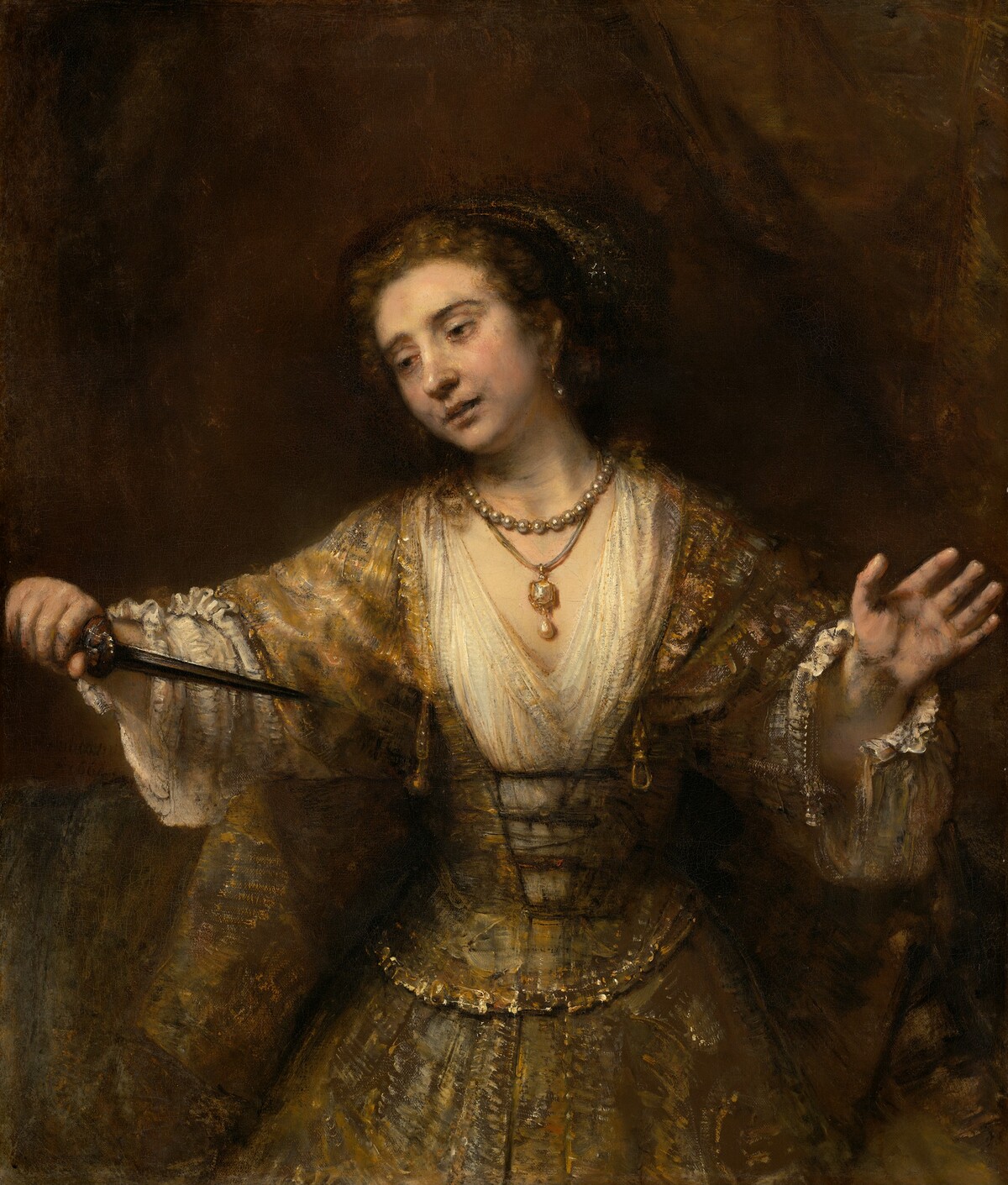
Provenance
Jean-Joseph-Pierre-Augustin Lapeyrière [1779-1831, known as Augustin Lapeyrière, then de Lapeyrière], Paris; (his sale, Galerie Le Brun, Paris, 19 April 1825 and days following [originally scheduled for 14 March 1825 and days following], no. 143). Michael M. Zachary [d. 1837], London;[1] (sale, Phillips, London, 14-15 April 1826, 1st day, no. 64, bought in); (Zachary sale, Phillips, London, 31 May 1828, no. 25); purchased by Sir Thomas Lawrence [1769-1830] for Hugh Andrew Johnstone Munro [1797-1864], London, and Novar House, near Evanton, Ross-shire, Scotland.[2] Paul Pavlovich Demidoff [1839-1885], Prince of San Donato, near Florence; (his sale, at his residence, Florence, 15 March-10 April 1880, no. 1146). (Léon Gauchez, Paris); (sale, Christie, Manson & Woods, London, 13 July 1889, no. 56, bought in); (Léon Gauchez, Paris), until at least 1893.[3] (Bourgeois & Cie., Paris); (Leo Nardus [1868-1955], Suresnes, France, and New York);[4] Matthew Chaloner Durfee Borden [1842-1912], New York, by 1906;[5] (his estate sale, American Art Association, New York, 13-14 February 1913, 1st day, no. 28); (M. Knoedler & Co., New York and Paris);[6] sold 1913 to (Frederik Müller and Co., Amsterdam); sold 1913 to August Janssen [1863-1918], Amsterdam;[7] his estate; sold 1919 with the entire Janssen collection to (Jacques Goudstikker, Amsterdam).[8] Hermann Heilbuth [1861-1945], Copenhagen, by 1920.[9] (Ehrich Brothers, New York), in 1921.[10] (M. Knoedler & Co., New York and Paris); sold November 1921 to Andrew W. Mellon, Pittsburgh and Washington, D.C.; deeded 28 December 1934 to The A.W. Mellon Educational and Charitable Trust, Pittsburgh; gift 1937 to NGA.
[1] Although the main seller at the April 1826 sale was Lord Berwick, there were also other consignors. One annotation in the Wallace Collection (London) Library’s copy of the sale catalogue indicates that Zachary was the consigner of the NGA painting; another annotation next to the Lucretia entry reads “Sir T Lawrence.” The Getty Provenance Index© Database, Sale Catalogs, lot 0064 from sale catalog Br-2806, identifies the latter annotation as indicating a previous owner.
[2] This information is given by Cornelis Hofstede de Groot, _Beschreibendes und kritisches Verzeichnis der Werke der hervorragendsten holländischen Maler des XVII. Jahrhunderts_, 10 vols., Esslingen and Paris, 1907-1928: 6(1915):120, no. 218 (also English edition, Cornelis Hofstede de Groot, _A Catalogue Raisonné of the Works of the Most Eminent Dutch Painters of the Seventeenth Century_, trans. Edward G. Hawke, 8 vols., London, 1907–1927: 6(1916):143-144, no. 218). However, the Wallace Collection (London) Library’s copy of the sale catalogue is annotated with the name “Woodin” as the buyer (The Getty Provenance Index© Database, Sale Catalogs, lot 0025 from sale catalog BR-3135). Munro acquired a significant collection that was dispersed in sales both before and after his death, but the painting has not been located in any of the sale catalogues. Hofstede de Groot lists a Munro sale in London on 26 March 1859 (given as 26 March 1851, in the 1920-1921 exhibition catalogue), which has not been identified; the painting does not appear in a sale of Munro’s English pictures held in London on 26 March 1860.
[3] Although Algernon Graves, _Art Sales from early in the eighteenth century to early in the twentieth century (mostly old master and early English pictures)_, 3 vols. London, 1918-1921: 2:383, gives the buyer at the 1889 sale as Wontner, the painting was in fact bought in and returned to the consignor, Gauchez. This information was kindly provided by Lynda McLeod, Librarian, Christie’s Archives, London, in her e-mail of 28 March 2013 (in NGA curatorial files). Émile Michel (_Rembrandt: Sa vie, son oeuvre et son temps_, Paris, 1893: 489) saw the painting in Paris, but did not identify the owner, who is named by Malcolm Bell (_Rembrandt Van Rijn and His Work_, London, 1899: 157).
[4] Jonathan Lopez kindly provided this information (oral communication, 13 October 2006). See also Jonathan Lopez, "'Gross False Pretences': The Misdeeds of Art Dealer Leo Nardus," _Apollo_, 2nd ser., vol. 166, no. 548 (December 2007): 78, 80, 82 nn. 25, 26.
[5] Wilhelm von Bode and Cornelis Hofstede de Groot, _The Complete Work of Rembrandt: History, Description and Heliographic Reproduction of All the Master's Pictures, with a Study of His Life and His Art_, translated by Florence Simmonds, 8 vols., Paris, 1897-1906: 8(1906):152, no. 595.
[6] Newspapers speculated that Knoedler’s might have been buying for the New York collector Henry Clay Frick; copies of various articles are in NGA curatorial files.
[7] The 1913 sales are described by Ben Broos, _Great Dutch Paintings from America_, exh. cat. The Hague and Zwolle, 1990: 69-70. See also Gerhardus Knuttel, "De Lucretia En Andere Werken Van Rembrandt Bij De Firma Fred. Muller & Co. Amsterdam," _Elsevier’s Geïllustreerd Maandschrift_ 47, no. 2 (January-June 1914): 137-144.
[8] “Janssen Paintings Sold in Holland,” _The Milwaukee Journal_ (3 August 1919): 10; Otto Hirschmann, “Die Sammlung August Janssen,” _Der Cicerone_ 12 (January 1920): 17-18.
[9] The painting was included in a 1920-1921 exhibition of Heilbuth’s collection in Copenhagen.
[10] René Gimpel, _Journal d’un collectionneur: marchand de tableaux_, Paris, 1963: 184-185.
Accession Number
1937.1.76
Medium
oil on canvas
Dimensions
overall: 120 x 101 cm (47 1/4 x 39 3/4 in.) | framed: 159.1 x 139.4 x 16.5 cm (62 5/8 x 54 7/8 x 6 1/2 in.)
Classification
Painting
Credit Line
Andrew W. Mellon Collection