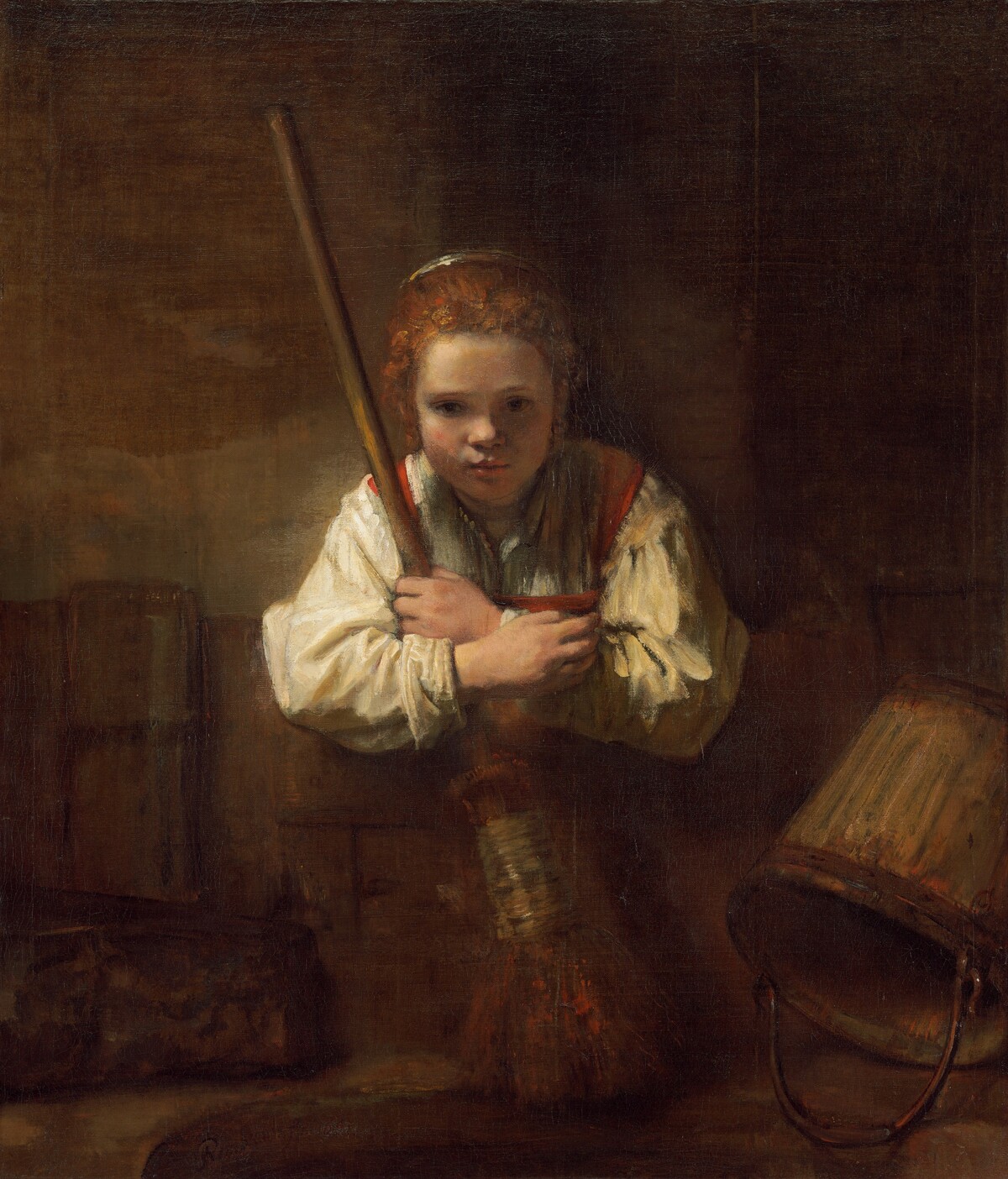
Provenance
Almost certainly Herman Becker [c. 1617-1678], Amsterdam.[1] Pierre Crozat [1665-1740], Paris, before 1740; by inheritance to his nephews, first to Louis-François Crozat, marquis du Châtel [1691-1750], Paris, and then [on Louis-François' death without a male heir] to Louis-Antoine Crozat, baron de Thiers [1699-1770], Paris; the latter's heirs; purchased 1772, through Denis Diderot [1713-1784] as an intermediary, by Catherine II, empress of Russia [1729-1796], for the Imperial Hermitage Gallery, Saint Petersburg; sold February 1931, as a painting by Rembrandt, through (Matthiesen Gallery, Berlin; P. & D. Colnaghi & Co., London; and M. Knoedler & Co., New York) to Andrew W. Mellon, Pittsburgh and Washington, D.C.; deeded 1 May 1937 to The A.W. Mellon Educational and Charitable Trust, Pittsburgh; gift 1937 to NGA.
[1] For Becker's collection, see Hugo J. Postma, "De Amsterdamse verzamelaar Herman Becker (c. 1617-1678) Nieuwe gegevens over een geldschieter van Rembrandt," _Oud-Holland_ 102 (1988): 1-21. The painting appears in the 1678 inventory (fol. 285r as "Een vrouwtje aende put van Rembrandt van Rijn").
Accession Number
1937.1.74
Medium
oil on canvas
Dimensions
overall: 107.3 × 91.4 cm (42 1/4 × 36 in.) | framed: 135.26 × 120.65 × 7.62 cm (53 1/4 × 47 1/2 × 3 in.)
Classification
Painting
Credit Line
Andrew W. Mellon Collection