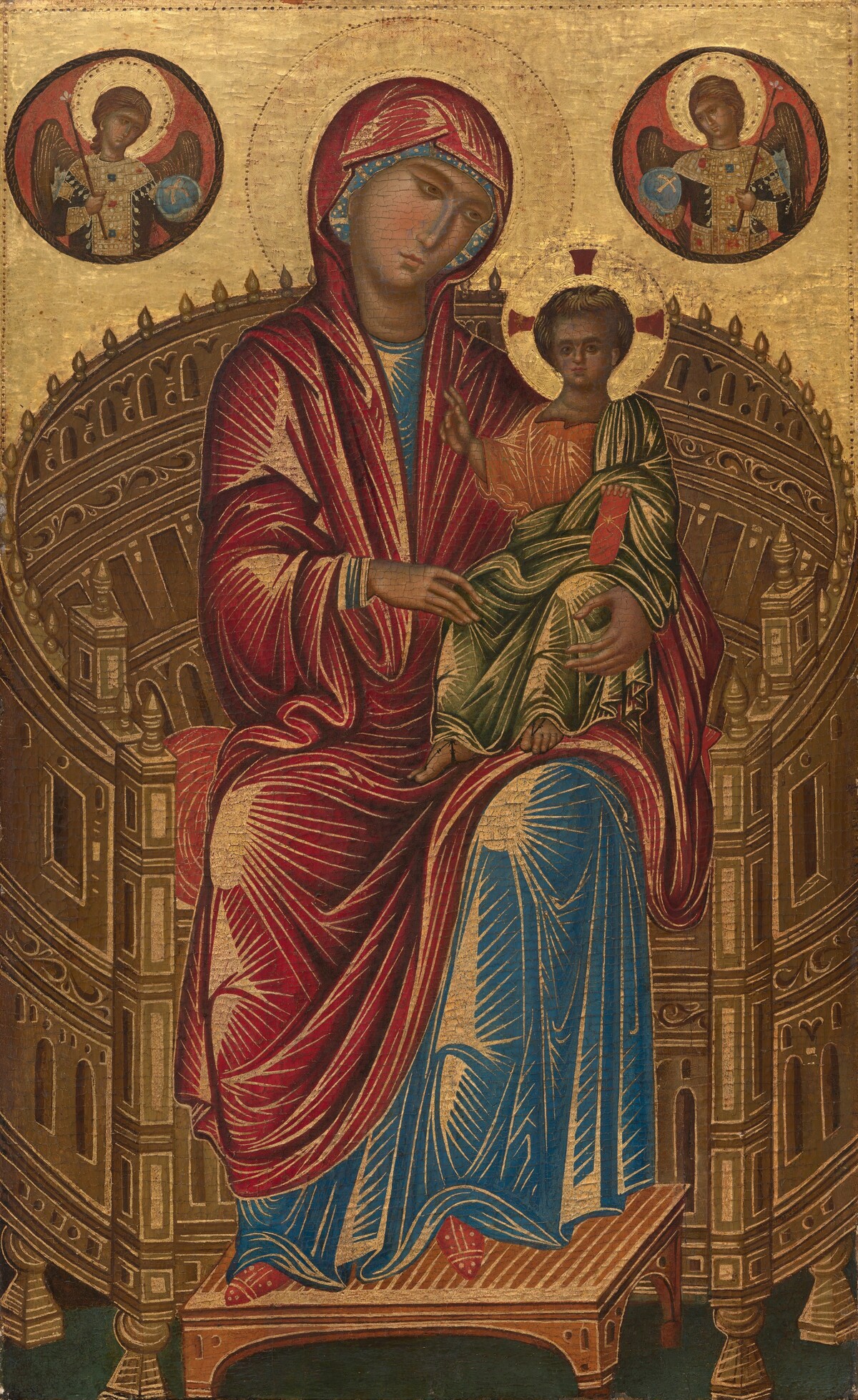
Provenance
Said to have come from a church, or convent, in Calahorra (province of La Rioja, Spain). Gabriel Dereppe, Madrid;[1] purchased 11 September 1919 by (Duveen Brothers, Inc., London, New York, and Paris);[2] Carl W. Hamilton [1886-1967], New York, early 1920s;[3] (Duveen Brothers, Inc., London, New York, and Paris);[4] sold 15 December 1936 to The Andrew W. Mellon Educational and Charitable Trust, Pittsburgh;[5] gift 1937 to NGA.
[1] The provenance from Calahorra, reported for the first time by Bernard Berenson (“Due dipinti del decimo secondo secolo venuti da Costantinopoli,” _Dedalo_ 2 (1921): 284-304), and then repeated in the subsequent literature, has sometimes been doubted, but, according to NGA systematic catalogue author Miklòs Boskovits, not on any good grounds. (See also the provenance for NGA 1949.7.1.) Writing from Madrid, Dereppe brought the painting to the attention of Duveen Brothers in a letter of 25 May 1918; he commented that he believed it to be by Pietro Cavallini and compared it to the Kahn painting (NGA 1949.7.1) that he had seen in New York. He said the painting at that time was actually with the Goya critic Aureliano de Beruete y Moret; Duveen Brothers Records, accession number 960015, Research Library, Getty Research Institute, Los Angeles: reel 212, box 357, folder 7; copies in NGA curatorial files.
[2] Generally (see Fern Rusk Shapley, _Catalogue of the Italian Paintings_, 2 vols., Washington, D.C., 1979: 1:96), first Carl Hamilton, and then Duveen Brothers, Inc., are cited as the owners of the painting, but this order needs to be reversed. It is well known that the majority of Hamilton’s paintings came from Duveen. According to Meryle Secrest (_Duveen. A Life in Art_, New York, 2004: 421, though she confuses the Kahn and Hamilton Madonnas, both with a provenance from Calahorra), Hamilton agreed to purchase NGA 1937.1.1 from Duveen Brothers (who had evidently offered the painting to him) in 1919. This is corroborated by the information on the provenance of the painting collected by Katherine Baetjer of the Metropolitan Museum of Art, New York, when the Duveen papers were held by that institution. She reports (in her letter to Jaroslav Folda of 16 September 1985; copy in the NGA curatorial files) that the Mellon Madonna “was purchased ... for the Paris branch of Duveen ... on 11 September 1919, as a work of Cavallino.” Duveen Brothers Records, accession number 960015, Research Library, Getty Research Institute, Los Angeles: reels 8–11, boxes 17–26 (New York Stock Books); reels 36 and 37, boxes 105–109 (Paris Stock Books); reel 422 (the X-book, 1910–1927).
[3] Berenson (1921) reported that the panel was in the Hamilton collection; evidently it was one of the paintings from Duveen Brothers with which “Hamilton was furnishing his [New York] city apartment....on credit” (see Edward Fowles, _Memories of Duveen Brothers_, London, 1976: 127-129). Indeed, Hamilton refers to the painting as in his possession when he writes to Joseph Duveen on 21 December 1921, enclosing Stephen Pichetto’s translation of Berenson 1921; Duveen Brothers Records, accession number 960015, Research Library, Getty Research Institute, Los Angeles: reel 161, box 306 (copy in NGA curatorial files).
[4] In 1921 Hamilton declared he was unable to pay for the paintings furnished to him on credit by Duveen Brothers, Inc., and returned them, at least in large part (Fowles 1976: 127-129). The panel continued to be cited in the literature for many years as belonging to Hamilton, but it must have been returned to the dealer at least by 1923, when it re-appeared in Duveen’s New York stock books (see the letter of Katherine Baetjer cited in note 2). It was during these years that the painting must have been subjected to a new restoration, the result of which is illustrated by the reproduction in Emilio Cecchi, _Trecentisti senesi_, Rome, 1928: 12. In the English edition of his study (_Studies in Medieval Painting_, New Haven, 1930: 4-16), Berenson described the panel as having previously belonged to the Hamilton collection.
[5] The original bill of sale is in Records of The A.W. Mellon Educational and Charitable Trust, Subject Files, Box 2, Gallery Archives, NGA; copy in NGA curatorial files. The provenance "from a convent in Calahorra, Spain" (see note 1) is given on the invoice.
Accession Number
1937.1.1
Medium
tempera on linden panel
Dimensions
painted surface: 82.4 × 50.1 cm (32 7/16 × 19 3/4 in.) | overall: 84 × 53.5 cm (33 1/16 × 21 1/16 in.) | framed: 90.81 × 58.26 × 7.62 cm (35 3/4 × 22 15/16 × 3 in.)
Classification
Painting
Credit Line
Andrew W. Mellon Collection