Provenance
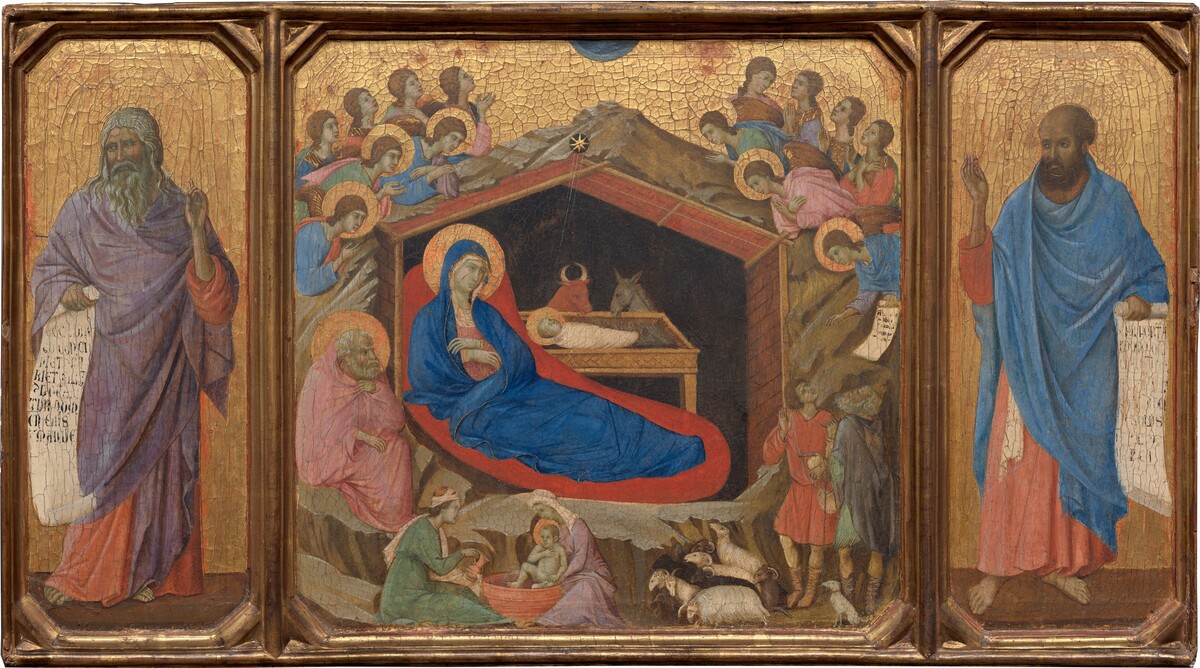
NGA 1937.1.8 formed part of the front predella of Duccio's double-sided altarpiece the _Maestà_, which was in the course of execution by October 1308 and was placed on the high altar of the Cathedral of Siena on 30 June 1311;[1] the altarpiece was removed from the cathedral in 1506, first stored by the Cathedral authorities, and then later displayed on the wall of the left transept, close to the altar of Saint Sebastian, but probably by this time the predella and gable panels had already been separated from it;[2] the altarpiece was moved to the church of Sant'Ansano in 1777, where its two sides were separated and returned to the cathedral;[3] in 1798 the gables and eight panels of the predella were reported as being kept in the sacristy of the cathedral, whereas the rest, including NGA 1937.1.8, must already have been in private hands.[4] probably with Charles Fairfax Murray [1849-1919], London and Florence, in the early 1880s,[5] who seems to have been the seller, in 1884, to the Gemäldegalerie der Königliche Museen, Berlin; deaccessioned 1937[6] and exchanged with (Duveen Brothers, Inc., London, New York, and Paris);[7] purchased 26 April 1937 by The A.W. Mellon Educational and Charitable Trust, Pittsburgh;[8] gift 1937 to NGA.
[1] The documents are published in Jane Immler Satkowski, _Duccio di Boninsegna. The Documents and Early Sources_, ed. Hayden B.J. Maginnis, Atlanta, 2000: 69-81, and in Allesandro Bagnoli et al., eds., _Duccio: Siena fra tradizione bizantina e mondo gotico_, Siena, 2003.: 577-579.
[2] See Alessandro Lisini, “Notizie di Duccio pittore e della sua celebre ancona,” _Bullettino senese di storia patria_ 5 (1898): 24-25. According to this author, in 1506 the altarpiece "venne confinata in certi mezzanini dell'Opera [del Duomo]...e per introdurvela fu necessario di togliere tutte le cuspidi e gli accessori" ("was stored in certain passages in the Opera del Duomo...and to enter there it was necessary to cut off all the pinnacles and accessories"). This latter term presumably comprises the predella. Lisini stated that only "sulla fine del secolo" - i.e., at the end of the sixteenth century - was the painting brought back to the cathedral. In Giovanna Ragionieri's opinion, however, the altarpiece had already been returned to the cathedral in 1536 and installed near the altar of Saint Sebastian. See Giovanna Ragionieri, in _Duccio: Siena fra tradizione bizantina e mondo gotico_, ed. Alessandro Bagnoli et al., Siena, 2003: 212.
[3] See Pèleo Bacci, _Francesco di Valdambrino, Emulo del Ghiberti e collaboratore di Jacopo della Quercia_, Siena, 1936: 185-186. The author did not mention the gables and predella; these had probably been separated earlier from the rest of the altarpiece (see the previous note). After the separation of the two sides of the main panel, the front with the image of the Madonna and Child enthroned in majesty surrounded by saints and angels was hung in its former place in the left transept, and the narrative scenes of the back were hung in the opposite transept.
[4] See Bacci 1936, 187. Vittorio Lusini specified that, apart from the twelve scenes of the gable, eight panels of the predella were present in the sacristy at this time, i.e., one more than the predella panels now preserved in the Museo dell'Opera Metropolitana del Duomo in Siena. The identity of this eighth scene is uncertain, but presumably it was different from those that reappeared in private hands in the second half of the nineteenth century. See Vittorio Lusini, _Il Duomo di Siena_, 2 vols., Siena, 1911-1939: 2:77. The seven predella panels now in the Siena cathedral museum represent the Adoration of the Magi, the Presentation in the Temple, the Massacre of the Innocents, the Flight into Egypt, and Christ among the Doctors from the front predella, and the Temptation on the Temple and the Wedding at Cana from the rear predella. James Archer Crowe and Giovanni Battista Cavalcaselle, around the mid-nineteenth century, were only able to see six predella panels in the sacristy of the cathedral: the much damaged _Temptation on the Temple_ and the eighth panel of unknown subject were no longer there. See Joseph Archer Crowe and Giovan Battista Cavalcaselle, _A New History of Painting in Italy from the Second to the Sixteenth Century_, 3 vols., London, 1864: 2:44 n. 1. Curt H. Weigelt discovered _Temptation on the Temple_ in the storerooms of the Opera del Duomo in 1909, whereas the eighth panel has so far not been identified. See Curt H. Weigelt, “Contributo alla ricostruzione della _Maestà_ di Duccio di Buoninsegna nel Museo della Metropolitana di Siena,” _Bullettino senese di storia patria_ 16, no. 2 (1909): 191–214. The predella, its many panels now divided among various museums in the world, was probably disposed of by the Opera del Duomo during the eighteenth century, and was at first privately owned in Siena.
[5] No source, as far as Miklós Boskovits knows, claims that Fairfax Murray actually owned the painting; however, James Stubblebine plausibly suggests this (_Duccio di Buoninsegna and his school_, Princeton, 1979: 37). In fact, in 1883 the English painter-dealer sold two other panels of the predella of the _Maestà_ to the National Gallery in London, those representing the _Annunciation_ and the _Healing of the Man Born Blind_ (nos. 1139, 1140). In 1886 he sold four additional panels of the predella to Robert Benson in London (one of these is NGA 1939.1.141). It seems that he initially had hoped to sell them all to the Gemäldegalerie in Berlin and had tried to convince the gallery to purchase them, offering to give one of the panels as his gift. Significantly, Eduard Dobbert (“Duccio’s Bild 'Die Geburt Christi' in der Königlichen Gemälde - Galerie zu Berlin,” _Jakrbuch der Berliner Museen_ 6 (1885): 153-163) thanked Fairfax Murray for having helped him with information in his hypothetical reconstruction of the _Maestà_.
[6] Königliche Museen zu Berlin, _Beschreibendes Verzeichnis der Gemälde_, Berlin, 1891: 77, as no. 1062A. The painting is mentioned as having been relinquished by the Gemäldegalerie ("1937 abgegeben") in the museum's _Gesamtverzeichnis_, Berlin, 1996: 601. Helmut Ruhemann, _The Cleaning of Painting_, London, 1968: 41, remembers that the painting was "exchanged [...] for an average Holbein," and Fern Rusk Shapley, _Catalogue of the Italian Paintings_, 2 vols., Washington, D.C., 1979: 1:172 n. 12, quotes a letter of the same restorer to the National Gallery of Art, according to which the Duccio predella panel "was exchanged in the 1930s by the Gemäldegalerie for a painting by Cranach." This was evidently a slip of the pen; the exchanged picture was the _Portrait of a Man with Lute_ by Holbein, no. 2154 in the Berlin gallery, which came from an American private collection and was acquired by the Gemäldegalerie in 1937 (_Gesamtverzeichnis_, Berlin, 1996: 60); see the following note.
[7] Duveen Brothers wrote to the director of the paintings department at the Berlin museum on 26 February 1937, offering the portrait by Holbein (then “said to be . . . of Jean de Dinteville,” from Henry Goldman’s collection) in exchange for two paintings in Berlin, this painting by Duccio and the Fra Filippo Lippi _Madonna and Child_, also in the National Gallery of Art (NGA 1939.1.290; Miklós Boskovits and David Alan Brown, _Italian paintings of the Fifteenth Century_, Washington, D.C. and New York, 2003: 401-405). Bernard Berenson’s opinion about the painting came in a letter dated 15 March 1937. By April, Duveen’s offices in Paris and New York were exchanging messages concerning conservation work on the painting, and David Finley had seen the painting for Andrew Mellon by early May. Duveen Brothers Records, accession number 960015, Research Library, Getty Research Institute, Los Angeles: reel 48, box 139, folder 4; reel 92, box 237, folder 23; reel 189, box 334, folder 2; reel 192, box 237, folder 23; copies in NGA curatorial files. See also Duveen Brothers, Inc., _Duveen Pictures in Public Collections of America_, New York, 1941: 6.
[8] The Mellon Trust purchase date is according to Mellon collection records in NGA curatorial files and David Finley's notebook (donated to the National Gallery of Art in 1977, now in Gallery Archives).
Accession Number
1937.1.8
Medium
tempera on single poplar panel
Dimensions
painted surface (left side image): 43 × 16 cm (16 15/16 × 6 5/16 in.) | painted surface (center image): 43 × 43.9 cm (16 15/16 × 17 5/16 in.) | painted surface (right side image): 43 × 16 cm (16 15/16 × 6 5/16 in.) | overall (including original frame): 48 × 86.8 × 7.9 cm (18 7/8 × 34 3/16 × 3 1/8 in.) | framed: 56.52 × 96.52 × 15.24 cm (22 1/4 × 38 × 6 in.)
Classification
Painting
Credit Line
Andrew W. Mellon Collection