Provenance
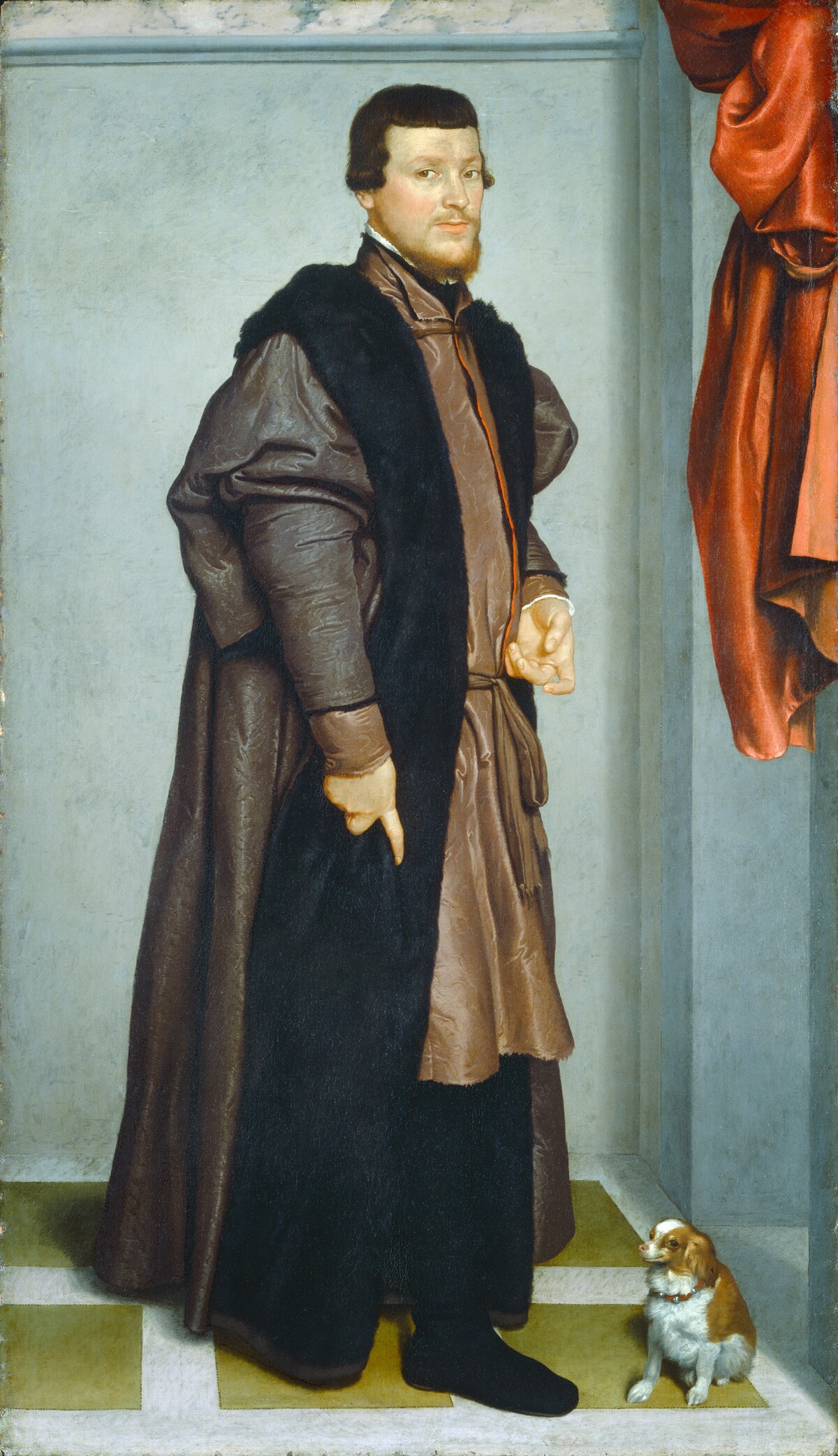
Commissioned by the Madruzzo family, Prince Bishops of Trent, Castello del Buon Consiglio, Trent, Italy, until 1658; by inheritance to Baroni di Roccabruna, Trent;[1] by inheritance 1735 to Baroni Gaudenti della Torre, Trent; by inheritance by 1833 to Baroni Salvadori, Casa Salvadori, Trent; by inheritance to Baroni Isidro and Valentino, Salvadori, Casa Salvadori, Trent;[2] sold 1907 through (Trotti et Cie., Paris) and (M. Knoedler & Co., Paris) to James Stillman [d. 1918], New York; by inheritance to Charles Chauncey Stillman, New York;[3] (Stillman sale, American Art Association, New York, 3 February 1927, no. 28); purchased by (M. Knoedler & Co., New York); by whom sold to William R. Timken [1866-1949], New York; by inheritance to his widow, Lillian Guyer Timken [1881-1959], New York; bequest 1960 to NGA.
[1] According to the Madruzzi family inventory, _inventarium mobilium castri boni consili_, p. 19. [2] According to G. B. Emert,_Fonti manoscritti inedite per la storia dell'arte nel Trentino_, 1939, p. 138. This year is when the Roccobruna family became extinct and the painting passed to the Baroni Guadenti. [3] According to Lionello Venturi, _Italian Paintings in America_, New York, 1933, vol. III, p. 538.
Accession Number
1960.6.27
Medium
oil on canvas
Dimensions
overall: 201.9 x 116.8 cm (79 1/2 x 46 in.) | framed: 237.5 x 153 x 8.4 cm (93 1/2 x 60 1/4 x 3 5/16 in.)
Classification
Painting
Credit Line
Timken Collection