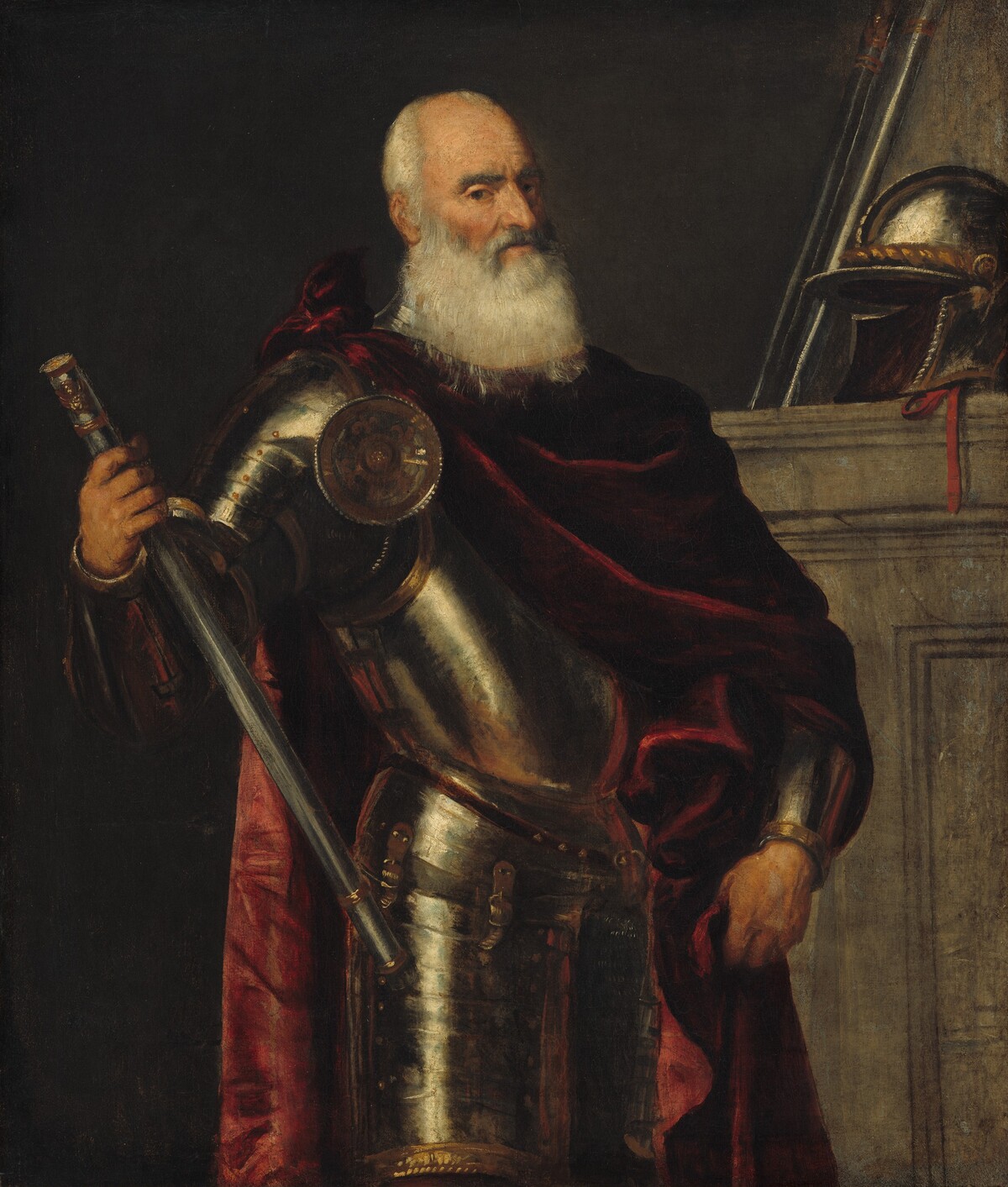
Provenance
Probably William Beckford [1760-1844], Fonthill Abbey, Wiltshire, and Bath, England;[1] by inheritance to his son-in-law, Alexander Hamilton, 10th duke of Hamilton [1767-1852], Hamilton Palace, Strathclyde [near Glasgow], Scotland; by inheritance to his son, William Alexander Anthony Archibald Douglas, 11th duke of Hamilton [1811-1863], Hamilton Palace; by inheritance to his son, William Alexander Louis Stephen Douglas-Hamilton, 12th duke of Hamilton [1845-1895], Hamilton Palace; (Hamilton Palace sale, Christie, Manson & Woods, London, 17, 19, and 20 June 1882, no. 410, as _Portrait of an Admiral in Armour_ by Tintoretto); (P. and D. Colnaghi, London and New York); sold 1882 to Henry Bingham Mildmay [1828-1905], London, Shoreham Place, Kent, and Flete House, Devon; (his sale, Christie, Manson & Woods, London, 24 June 1893, no. 73, as _Portrait of a Venetian Admiral_ by Tintoretto); purchased by (Thos. Agnew & Sons, Ltd., London) for Archibald Philip Primrose, 5th earl of Rosebery [1847-1929], Dalmeny House, Midlothian, Scotland; probably Albert Edward Harry Mayer Archibald Primrose, 6th earl of Rosebery [1882-1974], Dalmeny House; sold 1954 through (Wildenstein & Co., New York) to the Samuel H. Kress Foundation, New York;[2] gift 1957 to NGA.
[1] The picture was first certainly recorded in the Hamilton Palace sale of 1882, but the most important part of this collection was inherited by the 10th Duke of Hamilton from his father-in-law, William Beckford. An inventory of Beckford’s collection at Lansdown Crescent, Bath, of 1844 includes in the Great Drawing Room an item described as a “Portrait of a Spanish Admiral in armour holding a Baton, Tintoretto” (Bodleian Library, Oxford, Beckford Papers, c.58, 13 September 1844; information kindly provided by Jeannie Chapel). Since the Gallery’s picture was attributed to Tintoretto in the sale of 1882, it is likely that it corresponds to the Beckford picture: see Fern Rusk Shapley, _Paintings from the Samuel H. Kress Collection: Italian Schools, XV–XVI Century_, London, 1968: 181-182; Fern Rusk Shapley, _Catalogue of the Italian Paintings_, 2 vols., Washington, 1979: 1:485–488, and the correspondence between Fern Rusk Shapley and R.E. Hutchison, Keeper, Scottish National Portrait Gallery, Edinburgh, March-April 1967, in NGA curatorial files. When in Venice on his Grand Tour in 1780, Beckford particularly admired the work of Tintoretto, and it is possible that he acquired the picture then. See Jeannie Chapel, “William Beckford: Collector of Old Master Paintings, Drawings, and Prints,” in _William Beckford, 1760-1844: An Eye for the Magnificent_, ed. Derek E. Ostergard, exh. cat. Bard Graduate Center for Studies in the Decorative Arts, Design and Culture, New York; New Haven and London, 2001: 234.
As a possible alternative early provenance, it is worth noting that the inventory of the collection of Bartolomeo della Nave, Venice, acquired by the Marquess of Hamilton in 1638, includes an item described as “A Picture of General Capello Pal 2 & 1 Titian.” Hamilton (later 1st Duke) was an ancestor of the 10th Duke; and although the bulk of the ex-Della Nave collection was sold to the archduke Leopold Wilhelm after Hamilton’s execution in 1649, it is possible that this particular picture remained in the family until the 19th century. (This possibility is not disproved by a marginal note on the inventory, implying that the ex-Della Nave portrait of Cappello passed from the Hamilton collection to that of the Duke of Devonshire, since as pointed out by Ellis Waterhouse, “Paintings from Venice for Seventeenth-Century England,” _Italian Studies_ 7 ([1952]): 7, these marginal notes are highly unreliable.) On the other hand, there is no trace of anything corresponding to the Gallery’s picture in the various Hamilton inventories of the 17th and 18th centuries; see Waterhouse 1952, 7, and the Shapley-Hutchison correspondence cited above. Furthermore, the dimensions given in the Della Nave inventory (2 x 1 palms = c. 44 x 22 cm) do not correspond; and although the measurements given in the inventory are often very inaccurate, the reference here appears to be to a much smaller picture.
Shapley 1979, 1:485-488, also hypothetically identified the Gallery’s picture with one recorded by Ridolfi, a work by Titian then in the collection of Senator Domenico Ruzzino in Venice: “Il ritratto di Vicenzo Cappello General di Mare, in arme brunite tocche con belle osservationi di lumi, nelle quale reflette il manto purpureo, che gli attraversa alle spalle, afflibato co’ globbi d’oro, celebratissimo per il soggetto e per l’Autore;” Carlo Ridolfi, _Le maraviglie dell’arte, overo Le vite de gl'illustri pittori veneti, e dello stato_ (Venice, 1648), ed. Detlev von Hadeln, 2 vols., Berlin, 1914-1924: 1(1914):200. But the reference to the fixing of the cloak with “globbi d’oro” does not correspond to the present picture, and suggests rather the arrangement seen in Palma Giovane’s later portraits of Niccolò Cappello (Stefania Mason Rinaldi, _Palma il Giovane: L’opera completa_, Milan, 1984: 80, no. 57; 101, no. 207).
[2] See letters of 14 March and 24 April 1967 from Fern Rusk Shapley to Mr. R.E. Hutchison (from the correspondence cited in note 1), in NGA curatorial files. The painting was included in a Wildenstein bill of sale for fourteen paintings (copy in NGA curatorial files, see also The Kress Collection Digital Archive, https://kress.nga.gov/Detail/objects/2447), dated February 10, 1954; payments by the Foundation continued to March 1957.
Accession Number
1957.14.3
Medium
oil on canvas
Dimensions
overall: 141 x 118.1 cm (55 1/2 x 46 1/2 in.) | framed: 169.2 x 135.3 x 10.2 cm (66 5/8 x 53 1/4 x 4 in.)
Classification
Painting
Credit Line
Samuel H. Kress Collection